春季促销!结账时享七折优惠


Ancient Dzi Shop
Ancient Indus Valley Beveled Carnelian Bead, 28.2mm, translucent orange-red, ancient chipping disclosed (Ac-071026-CBEV)
Ancient Indus Valley Beveled Carnelian Bead, 28.2mm, translucent orange-red, ancient chipping disclosed (Ac-071026-CBEV)
We never retouch our photos. What you see is exactly what you will receive.
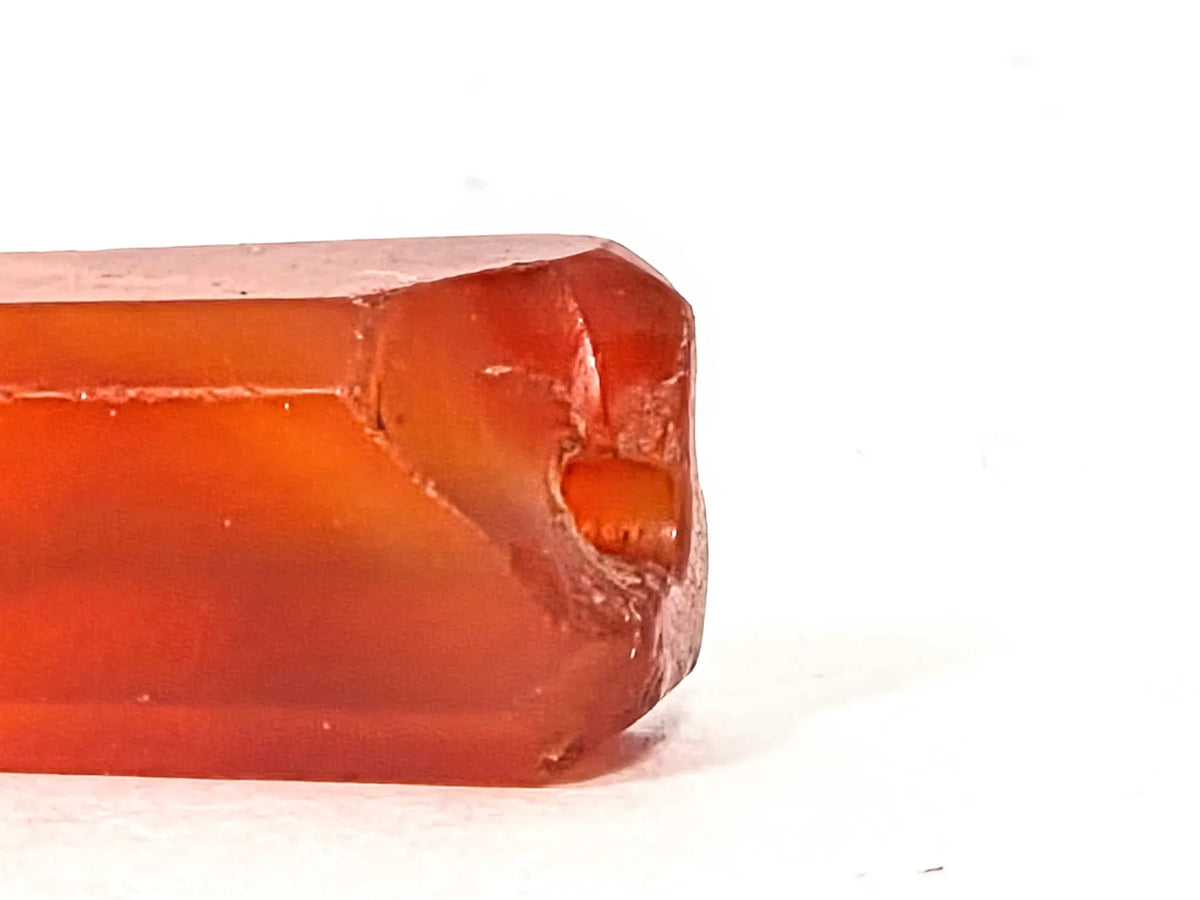
The drill hole at one end of this bead is no longer round. Centuries of cord wear have worked it into an oval — the carnelian walls of the channel smoothed and elongated by the passage of whatever fibre it was strung on across the full span of its working life. Around that hole, the carnelian has fractured away in an area of significant ancient chipping: multiple breaks radiating outward from the drill opening, the broken surfaces carrying the same warm orange-red patina as the rest of the bead, confirming the damage is old and entirely consistent with centuries of active use. The body of the bead — all four polished faces and their beveled edges — is intact and undamaged. The photographs show every face and both ends, including two macro close-ups of the chipped end, so the condition is fully visible before purchase.
The form itself is the first thing to understand about this bead's origin. The rectangular cross-section with beveled edges running the full length — a technique that replaces four sharp corners with four angled facets, creating a subtle eight-sided profile — is one of the defining characteristics of Indus Valley bead-making. This method of finishing carnelian and other hardstones was highly developed in the ancient workshops of the Indus Valley civilisation and its successor cultures, and continued to be practiced in the broader region across many centuries. The beveled rectangular form is immediately recognisable to collectors of ancient South Asian material.
The carnelian itself is high-quality translucent material: a warm orange-red that shifts between brighter orange and deeper wine-red depending on the viewing angle, with natural internal banding visible through the stone when backlit. The surface of the four body faces retains its original polish — smooth and glassy, with the depth of colour visible through the translucent material. The slight natural taper (7.7mm at one end, 8.6mm at the other) is an inherent characteristic of this piece, visible in the photographs.
This bead was sourced in Nepal and is consistent in form and material with Indus Valley regional bead-making traditions. At 500–1,000 years of estimated age, it represents a link to a craft tradition that stretches back several millennia in the same geographic region.
The Beveled Carnelian Bead Tradition
The production of long carnelian beads with beveled rectangular cross-sections was one of the highest craft achievements of the ancient Indus Valley bead-making centres, particularly those associated with the Harappan civilisation and its successors. Carnelian — prized for its translucency, its warm orange-red colour, and its hardness — was shaped, ground, drilled, and polished to exacting standards. Beveled-edge rectangular beads were traded widely across the ancient world and have been found in archaeological contexts from the Persian Gulf to Mesopotamia. The form continued to be produced in the region across many centuries, making precise attribution by form alone difficult; what the beveled rectangular shape reliably indicates is membership in a long, deep craft tradition centred in the Indian subcontinent.
Specifications
Form: Rectangular with beveled edges (eight-sided long profile) — Indus Valley bead-making tradition
Length: 28.2mm
Width: 7.7mm (one end) × 8.6mm (other end) — slight natural taper
Material: Natural carnelian — translucent orange-red with natural internal banding
Origin: Indus Valley tradition; sourced in Nepal
Age Estimate: 500–1,000 years
Condition: Good for age. Four body faces smooth and intact. Significant ancient chipping at one drill end — multiple fractures around the drill opening, surfaces aged and patinated consistent with ancient damage. Drill hole at that end worn oval from centuries of cord use. Other drill end intact with minor wear. No fresh damage. Body undamaged.
Bloodspots: Not applicable — carnelian material
Product ID: Ac-071026-CBEV
Collections: Ancient Dzi · Carnelian Dzi & Pema Raka · All Products
Related Ancient Carnelian Dzi Beads
Carnelian beads share the Indus Valley heritage and ancient craftsmanship of this piece. Explore other fine examples from our ancient collection:
Ancient
Ancient Indus Valley Beveled Carnelian Bead, 29.2mm, vivid translucent orange-red, ancient chipping disclosed (Ac-071026-CBEV2) — $250.00
Two Eye, Heaven Gate & Tiger Tooth Carnelian Dzi, 23.7×12.1mm, 500–1,000 Years (Ac-083126-2EHGTT) — $800.00
Double Cross-in-Cross & Stars Carnelian Dzi, 29.1×12.2mm, beveled barrel (Ac-080426-DCCS) — $1,000.00
Ancient Twin Tiger Stripe & Tiger Tooth Carnelian Dzi, 26.5mm × 13.5mm, bicolour terracotta-red and grey-black, octagonal (Ac-061126-TSTT) — $1,000.00
Ancient Five Tiger Stripe Carnelian Dzi, 31.6×11.4mm, rare octagonal form, terracotta-red, 800–1,000 yrs (Ac-030525-5TS) — $1,100.00
Antique
Two Eye, Tiger Tooth & Stars Carnelian Dzi, 52.2 × 15.1mm, terracotta-red, chip disclosed (At-061426-2ETTSt) — $700.00
Two Eye Treasure Vase Dzi, Eye Within Vase, 29.6×11.4mm, Translucent Warm Reddish-Brown Chalcedony (At-061826-2ETV) — $1,200.00
Three Eye & Tiger Stripe Carnelian Dzi, 52.4 × 15.1mm, dark chocolate-brown (At-071322-3ETT) — $1,000.00
Antique Six Tiger Stripe Carnelian Dzi, 50.7mm × 12.9mm, chocolate-brown with bicolour end caps (At-070822-6TS) — $1,500.00
Three Diamond Eye & Tiger Tooth Carnelian Dzi, 27.2 × 13.6mm, terracotta-red (At-053126-3DETT) — $600.00
Explore more carnelian pieces in our Carnelian Dzi & Pema Raka collection.
Explore more ancient pieces in our Ancient Dzi collection.
Browse all pieces in our full collection.
Further reading: Where Do Dzi Beads Come From? Origin, History & Mystery · What Gives Dzi Beads Value — and What to Be Careful Of
Every piece at Ancient Dzi Shop is photographed unretouched and described exactly as found. What you see is what you will receive.
Photos: Unretouched images of the exact bead listed. Eight product photographs: four white-background lateral views covering all four body faces, two angled views showing both drill ends, and two macro close-up photographs documenting the ancient chipping and oval wear at the damaged drill end.
#ancientcarnelian #indusvalleybead #carnelianbead #beveledcarnelian #ancientbead #indusvalley #carnelian #ancientdzishop #ancientagate #tibetanbeads #nepalantiques #carnelianantique #ancientjewelry #ancienttrade #ancientcollector
无法加载取货服务可用情况